Showing posts with label Narrative Stories. Show all posts

Sunday, 20 February 2022

Part 1: I Want to Tell you a Story - The L.A.W. GraphicNarrativ Seminar Series


During this lecture we looked at the following sources of inspiration and academic guidance:

In the first Lecture we looked at how Biography is used to shape a story. The discovery of a person’s life through the medium of the graphic novel. We looked at how academics have elevated the public appreciation of what this medium can deliver and why it should be respected. Books were used to illustrate my points in the lecture and links to these can be found below. 


During the lecture I proposed the idea that the truth was immediately affected by the observer as soon as analysis occurs and that the facts can be influenced by the agenda of the storyteller. As soon as you observe the facts, they become something else. The researcher can affect the results of an experiment just by looking at it or at the very least explains the results as an interpretation. Do graphic novels provide us with a slower way to observe truth and therefore provide more time for reflection and inspiration?Academic and Curators of the format who you can check out in the UAL Libraries or onlineNina MickwitzDocumentary Comics Graphic Truth-Telling in a Skeptical Age – Palgrave Studies in Comics and Graphic Novels

Roger SabinComics, Comix & Graphic Novels: A History of Comic Art

Paul GravettGRAPHIC NOVELS: Stories To Change Your Life

Scott McCloudUnderstanding Comics, Making Comics and Reinventing Comics 


Publishers of Graphic Novels 

Self Made Hero 

Draw & Quarterly 

Jonathan Cape 

Fantagraphics 


Graphic Novel CreativesAlison Bechdel – Fun Home which was adapted by the author into a stage play 


Sue Coe – Malcolm X 


Thomas Ott – R.I.P. 


Marjane Satrapi – Persepolis which was adapted by the author into an animated feature film 


Reinhard Kleist – Castro and Johnny Cash  


Catel Muller and José-Louis Bocquet - Kiki de Montparnasse: The Graphic Biography 


Joe Sacco - Palestine, Safe Area Goražde and Footnotes in Gaza 


References


Gravett, P. (2005) Graphic Novels: Stories to Change Your Life1. publ. edn. London: Aurum Press.

McCloud, S. (2010) Understanding comics1. HarperPerennial ed.; [Nachdr.] edn. New York: Harper Perennial.

McCloud, S. (2000) Reinventing comics1. ed. edn. New York, NY: Perennial.

McCloud, S. (2006) Making comicsNew York, NY: William Morrow.

Mickwitz, N. (2015) Documentary ComicsNew York: Palgrave Macmillan US.

Sabin, R. (2008) Comics, Comix & Graphic NovelsRepr. in pbk. edn. London: Phaidon.


Proposition Time
 

A new graphic novel about Malcolm X is proposed by me but my graphic novel wouldn’t feature Malcolm X at all. I’d only look at his influence. The gravitational force of his existence and how that impacts on the events of my story. 


I’m reminded of the film It’s A Wonderful Life (1946) where the protagonist gets to glimpse the world as it would be with out them. Look at your own life and consider the impact that you make on the lives of others or maybe look at a sibling and imagine the world without them.  

Telling a story of your own life, where would you start? We know that we were born but we don’t remember this event. So, where exactly would you start the story of your life? How would you introduce the concept of the gravitational force of one’s own life? 


Here are some exercises that will help you to begin to think about how you might construct a biographical story it would great to see the results too:• Write a short story using your earliest memory as a starting point 


• Please write your story in the third person. 
Writing in third person is writing from the third person point of view and uses pronouns like he, she, it, or they.


• 300 words maximum (you might wish to support this with your own drawings) 


• Please break your story into 3 paragraphs (a beginning, middle and end but not necessarily in that order) 


• Finally select an image that you feel best represents the meaning of your story (this can be original or secondary source) 


To help you construct your story look at these resources:

http://www.movieoutline.com/articles/the-hero-journey-mythic-structure-of-joseph-campbell-monomyth.html The Hero Journey

the heroes journey A story of three orphans

https://www.bbc.co.uk/iplayer/episode/b09vdpzw/imagine-winter-201718-4-philip-pullman-angels-and-daemons Imagine... Phillip Pullman: Angels and Daemons

Block, B. (2008) The visual story – creating the visual structure of film, TV and digital media. Oxford: Focal Press.

Booker, C. (2011) The Seven Basic Plots: Why We Tell Stories. London: Continuum International Publishing Group.

Madden, M. (2005) 99 ways to tell a story: exercises in style. London: Penguin Books.


Thursday, 6 August 2020

The Garden of Inside-Outside

Written by Chiara Mezzalama


Illustrated by Régis Lejonc


ISBN 978-1-911496-16-8


Published by Book Island


Reviewed by Karl Andy Foster


Publisher’s website https://www.bookisland.co.uk/products/the-garden-of-inside-outside?_pos=1&_sid=bf411036a&_ss=r


Illustrator’s website https://www.ricochet-jeunes.org/auteurs/regis-lejonc


Review


This is a story that sets out its context carefully as the events that surround and impact upon our young protagonist Chiara requires sensitive handling. A memoir framed against a turbulent period in the history of the middle east evokes the author’s remembrances of things past.


With similarities to a propaganda poster the cover of this graphic novel shows two children linking hands in a beautiful garden. Above their heads and outside the inside is the image of the Ayatollah Khamenei in ominous red and black. The paper stock also adds to this quality. On some pages there is not the conventual linear story but instead images that could be self-contained and work in their own right.


Throughout the story at the top of the pages we see either the word OUTSIDE in red to indicate danger or INSIDE in green for the more peaceful moments. Towards the end both OUTSIDE and INSIDE are shown together once another child Massoud enters the garden. Through their interactions the children process the realities of the world outside. They shape their fears into adventures and shared values into friendship.


The illustrations in this book remind me of linocuts or wood block printing. The limited palette of green, blue, red, yellow with black outlines helps to reinforce this impression. From arches to decorative tile work, from illustrated carpets to lush vegetation gone wild the line work is fluid and flows well. The drawing style is a combination of the powerful details found in David B.’s work and the graphic boldness of Marjane Satrapi’s illustrations.


This is a delightful story about friendship in unusual circumstances. Based on the biographical events of the author’s life and set during a time of revolution and war, it is the precious moments that cement our personalities and create the myths of our early years. At the end of this story there is a moment that reminds me of a line from A. E. Housman’s ‘A Shropshire Lad.’


That is the land of lost content, I see it shining plain,

The happy highways where I went

And cannot come again.”


This graphic novel is proof that it is necessary to relive your past and to share this with others.


9th March 2020


Small In The City

Written & Illustrated by Sydney Smith


ISBN: 978-1-4063-8840-4


Published by Walker Books


Reviewed by Karl Andy Foster


Publishers website http://www.walker.co.uk/Small-in-the-City-9781406388404.aspx


Sydney Smith https://www.sydneydraws.ca


Pitch

This is something special. Sydney Smith’s narrative power is his ability to immerse the reader into the world and concerns of a small child. His spare economical prose and exquisite artwork propels you towards a startling destination. This is an honest and credible story that after drawing you in leaves you satisfied, perhaps with one or two tears in your eyes.


Review

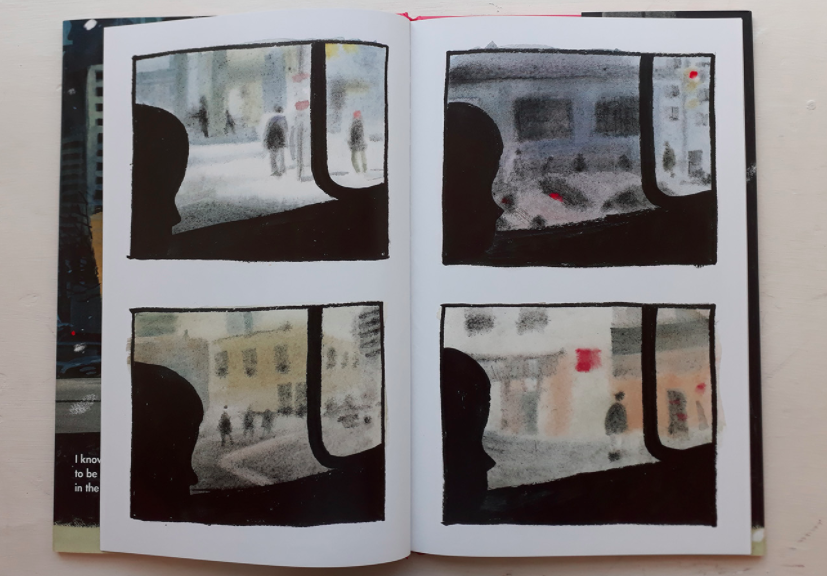
In this hard cover picture book there are some lovely observations visual and textual. The initial four panels with the silhouettes and blurred streets convey the sense of unease. A child roams around the city encountering a range of scenarios and offers advice that may or may not be of comfort to a stranger.


Sydney Smith’s carefully constructed pages are a mixture of full spreads and panels. Of note is the double page spread when the child leaves the bus and makes their way into the throng of the crowds. In addition, the words “I know what it’s like to be small in the city” or “The streets are always busy. It can make your brain feel like there’s too much stuff in it.” I particularly enjoyed “Alleys can be good shortcuts. But don’t go down this alley it’s too dark.” We are completely involved with the concerns of our young protagonist.


The grid lines of buildings, walk ways and street furniture create a web suggesting a trap for the uninitiated. There is a stunning picture of the child’s reflection fractured by the arrangements of the mirror tiles on a building façade. We soon realise that this advice is not aimed at the reader but at something far more important. The revelation at the end of the picture book came as a surprise for me but I did start to get an inkling of what was to come.


Sydney Smith has created a classic that will make a big impression on readers with a story that though simple is imbued with a graphic fluidity combined with a visual dexterity that few can match. This for me is reminiscent of Ezra Jack Keats’ atmospheric The Snowy Day when I read it for the first time. The artwork nods in a knowing direction towards Dave McKean’s ‘Cages’ and ‘The Savage.’ The use of a subtle and sophisticated palette suffused with interpretive impressionistic inky marks and charcoal lines is thrilling.


If this picture book and his 2017 Kate Greenaway Medal winning collaboration ‘Town Is by the Sea’ written by Joanne Schwartz is anything to go by Sydney Smith is on his way to great significance. When you are small in the city you can still have the biggest heart of all.


08 October 2019


Greta and the Giants

Written by Zoë Tucker


Illustrated by Zoe Persico


ISBN: 978-0-7112-5375-9


Published by Frances Lincoln Children’s Books


Reviewed by Karl Andy Foster


Publishers website https://www.quartoknows.com/books/9780711253773/Greta-and-the-Giants.html?direct=1


Zoe Persico website http://www.zoepersico.com


Review


Greta Thunberg is a 17-year-old, Swedish school child who has become famous through her stand to save the world, beginning when she was 15 years old outside the Swedish Parliament one Friday afternoon. I have written reviews for stories about living people before and it’s usually a real-life account that has been adapted to help craft the story into a cohesive narrative. This time a real person has been cast in a fictional tale to help children grasp the concept of activism.


The cover is like a poster for a classic Western movie where our heroine stands legs apart ready for the final showdown with an unknown foe. Her face is stony in its resolve but her weapon is a large placard stating “Strike for Climate.” In the background are two silhouetted figures, could these be the Giants mentioned in the books title? The production of this book using UK based suppliers and printers align with its ethical stance. Greenpeace is a beneficiary of the sales of this book.


Zoë Tucker has framed this story of defiance into a magical fable in the mold of Hans Christian Anderson or a Charles Kingsley creation. Children take on the adult world because they have to in this story. In such cases of adversity, we need the children to ask themselves if it’s possible to inspire by your words and actions and can they see themselves as capable of making a difference to the world. Greta has spoken truth to power across the globe and has as many fans as detractors, therefore she must be doing something right.


Zoe Perisco’s illustrations are bold, sophisticated, loose, dynamic using subtle tones of yellow, purple, brown, sage and hooker green. The figuration of the giants helps us to appreciate that they are engaged in their lives without much thought for the impact their desires are having on the planet. There are striking spreads in the book e.g. the city consuming the forest, the children marching, placards in hands and the resolution images showing us what the world could be like if we all acted to save it. The three circular vignettes towards the end of the story are rather ambiguous despite the text underneath them. The text refers to the behaviour of the Giants after Greta confronts them but the images look more like the children characters who are doing the protesting. I do wonder if an error has been made here.


We want our children to be the future but it is a complex matter these days. What will happen? Will the real Giants think about changing the world or is this an impossible future? Can children convince adult readers to engage with change to make a difference? Out of small acorns mighty oaks spring forth.


21 February 2020


Friday, 11 April 2014

PUZZLE (2005)

Can you work out the puzzle contained within this illustration narrative? 12 images = 12 clues
© Karl Foster 2014


'HOPE' (2005)

'HOPE' what we all need right about now as my illustration shows death is all too swift.

This narrative sequence was produced for the LCC Graphic Design staff show 'Tin Gods.' © Karl Foster 2014.