Showing posts with label Bloomsbury books. Show all posts

Thursday, 6 August 2020

The Graphic Design Reader

Edited by Teal Triggs & Leslie Atzmon


ISBN: HB: 978-1-4725-3620-4

            PB: 978-1-4725-2647-2


Published by Bloomsbury


Reviewed by Karl Andy Foster


Publishers website

https://www.bloomsbury.com/uk/the-graphic-design-reader-9781472526472/


Editors’ websites

Teal Triggs https://www.rca.ac.uk/more/staff/professor-teal-triggs/


Leslie Atzmon http://art.emich.edu/faculty/11


Pitch

This scholarly and engaging collection of key readings provides an excellent body of work for those who wish to understand how the subject of graphic design is moving from a field towards a discipline. You will learn that graphic design is everywhere, even when it’s invisible!


Review


Asking a designer to ‘rewire’ their thinking and notions of the ego

When I trained as a graphic designer more than 30 years ago my main concern was how to make the best work and how these efforts would help me to pay my bills. I had no notion of how my work would be appreciated beyond the D&AD and British and European illustration award systems. I seldom attempted to go beneath the surface of the subject but instead I praised the surface. Things have changed a great deal since then and it’s important to see that there is a complimentary area of study that all graphic designers need to reflect upon. If the subject is to have continued relevance in a world that’s facing multiple challenges we need to be ready for change.


Chapter headings, including the currency of education, the profession, type and typography and political and social change place this publication firmly in the worlds of professional making and knowledge dissemination. There is certainty about where graphic design might be heading. This book is an archive of the best in writing on the subject from the last 140 years beginning with William Morris and the Kelmscott Press (1888). It will be of interest to students of design, academics and other scholars. The Essays that range over seven chapters are drawn from those who have worked in the creative industries, educational and philosophical arenas.


The contributors to The Graphic Design Reader are impressive. Anil Aykan Barnbrook, Peter Bil’ak, Joanna Choukeir, Ken Garland, Anna Gerber, Jessica Helfand, Steven Heller, Ellen Lupton and William Morris to name but a few covering history, innovations, pedagogy and philosophy as well as the practical applications of this complex way of being. The editors have taken the time to find sources that will surely encourage further comment.


The status quo is not an option

They attempt to put a marker down for future scholars of the subject. Graphic Design has found a way to remain relevant and integrated into the everyday experiences of people’s lives globally. The discovery of how ideas were explored by embracing this multi-dimensional medium will help designers to embrace the analysis of their own work. The philosophical and psychological impact of graphic designer on its creators and readers is also covered in great detail.


When a scholar exposes the cultural, political and economic context of a dynamic industry might there still be room for the subjective? The Reader explores how we can use personal agency to help us to pursue answers to the complex problems facing designers today. This book forensically covers the alternatives to the status quo, suggesting that the theoretical must become an integral part of their personal and professional approach to graphic design and all future activities.


In conclusion

This Graphic Design Reader is a great introduction for design students covering as it does the arguments and philosophies surrounding this subject and its future directions. The essays and manifestos support the challenge of spreading understanding to an audience. We all need to be better equipped to take the subject forward into a discipline.

This book can be used to guide post-graduate design students through the arguments, practices and concepts from the world of communication design. It will also help them to understand what is happening out in industry and provide them with inspiration for further reading and research. It encourages us to be bold - so let’s see what’s out there.


Tuesday, 14 May 2019

My Book Review for The Power and Influence of Illustration by Alan Male

The Power and Influence of Illustration

Written by Alan Male

ISBN: 978-1-3500-2242-3
eBook: 978-1-3500-2411-3

Published by Bloomsbury Visual Arts

Publishers website 

Authors website 

I am an academic, writer and image-maker. When I read the title of this book I was somewhat taken aback. This is because the discipline of illustration has been undervalued and decried for years. Ignored by the public at large and dismissed as merely whimsical by the overinflated purveyors of fine art and graphic design. With the exception of the political cartoon it’s almost invisible to policy makers and economists. I wondered if it was possible to establish exactly how illustration has influenced societies and whether that influence could be attributed to real power. 

This book is organized into 4 chapters, the writing style flows well and is very engaging. This book will help the uninitiated and those contemptuous of the practice to appreciate the complex manner in which illustration reaches its audiences. There has always been a vast array of topics tackled by illustrators over the centuries but these tend not to be collected into one source as has finally happened thanks to Male’s work. I also note that the author quotes his own previous scholarship throughout. This may lead the reader to explore the subject to a greater depth. 

Alan Male’s arguments are most persuasive when set against the origins of art as part of human cultural expression. It is clear that illustration played a key role in the development of education and how we make sense of the world around us. From magical caves to mystical temples, from divinity in stained glass to sacred scrolls; illustration has been employed in the attempt to link our minds to the Gods. 

When he riffs on geopolitics and how todays social media might influence the rise of subversion this is where his thesis gets exciting and I would have liked to read more about this specific part of visual communication. When the artist creates propaganda for regimes just what are his responsibilities? Is anonymity acceptable when your work does potential harm. It is asserted that we must not work in a vacuum and that social and ecological concerns should always impact our decision making. He shows that he appreciates that illustration can be 2D, 3D, 4D and even AI. These technical developments are to be embraced rather than feared. In the latter part of the book he refers to how collaboration has made illustration more visible and this helps to maintain its links to the world of science and technology. His selection of specific images proves this point. The collaborative work of Anna and Elena Balbusso features heavily in these chapters as does that of Paul Davis particularly his #No More Black Targets work. 

I think this book is a compelling addition to Male’s early output and that the new graduate and committed design student would benefit from the knowledge within. The design of the publication shows some improvements on the last book I reviewed by this author but again some graphic vector-based artworks that would work well at the size of a postage stamp were shown at a scale that disadvantaged more delicate linear work that features complex text elements. 

This book contains a broad range of approaches deemed illustration and explains how this work impacts on the wider society. Some of the selected work is beautiful, refined and gives one pause for thought. There is an international selection that adds to the diversity of images on show. I’m still not fully convinced that this book will have a major impact beyond those directly involved in the production of illustration but it is good to see such ambition. Male looks forward to a time when we all become natural polymaths. Power to the people yes but also power to this book.


Tuesday, 3 July 2018

My Book Review for Reportage Illustration - Visual Journalism by Gary Embury & Marcelo Minichiello

Published:11-01-2018
Format:Paperback 
Edition:1st
Extent:176
ISBN:9781474224598
Imprint:Bloomsbury Visual Arts
Illustrations:200 colour illustration 


Gary Embury and Mario Minichiello have produced a book that works for me and this is why:

It reminds me of my own experience of producing reportage drawing during trips to Barbados, Barcelona, the Greek Islands and New York that is strongly backed up by the editorial tone of this book.

It contains some excellent case studies on artists who know how to capture the live scene. These artists are working across the globe and finding fascinating projects to engage with.

The many interviews attempt to discover the secrets of this skill and explain time and again that preparation is everything. Efficiency in planning is the most important thing we need to consider.

I have seen that Bloomsbury Visual Arts and Bloomsbury Academic books can be weak in page layout and the design front but this time they get it right. I commend them on this and urge them to continue in this vein. This book features some stunning examples of reportage work and the captions help build on the overall message. For me the highlights of this book come through the words and work of Olivier Kugler, Lucinda Rogers, Anne Howeson, Jenny Soep, George Butler and Sue Coe.

This book presents an effective guide to visual journalism. Contextualisation is something that we work hard to help our students to understand so they are able to create useful and original conceptual and practical outcomes. This book gives us a history and evolution of the subject and it respects illustration as an important part of our culture and appreciates that it is at the heart of visual communication.

I really like the reportage exercises in the book and I will soon use these with my illustration and visual media students. It also reminded me of the importance of direct observation drawing. This is a skill that takes focused concentration and application to achieve credible results.

This book makes clear the strong case for when observed drawing is superior to photography, cinematography and written journalism.

This book will be useful for academics and those who understand the reason for ‘dirtying the paper.’ It also explores the meaning of image making through the use of historical and contemporary examples. Reportage is an enterprise that has remained relevant and important despite the preponderance of 24/7 news (fake or otherwise) and our changing social interactions. So, go on location, start drawing and count how many people interact with you. They usually talk about their own lapsed drawing practice. I say take every opportunity that you can to get people talking about the making of art.

Karl Foster Monday 26 March 2018


Saturday, 4 March 2017

Illustration A Theoretical & Contextual Perspective - Written by Alan Male

Published by Bloomsbury Visual Arts 
ISBN: PB: 978-1-4742-6302-3
ePDF: 978-1-4742-6304-7
My Review
I am an Illustrator. I have been one for over 30 years. I was excited about reading this book, as I know of the author by reputation. It is quite dry and academic and the writing style doesn’t flow as well as it might. I persevered because my interest wasn’t diminished. I do wonder if some undergraduate students of design might be intimidated by academic writing. This book will be a challenge to the uninitiated and is probably more useful for post-graduate level study. It will also be useful for academics and practitioners of illustration. It explores the meaning of illustration through historical contexts and contemporary examples (many from tutors and alumni of Falmouth University) showing the vast array of topics tackled. This second edition includes an additional chapter that focuses on the inter-disciplinary nature of illustration practice and the potential for it to take the lead in the development of design. It is this that is the strength of Male’s argument.

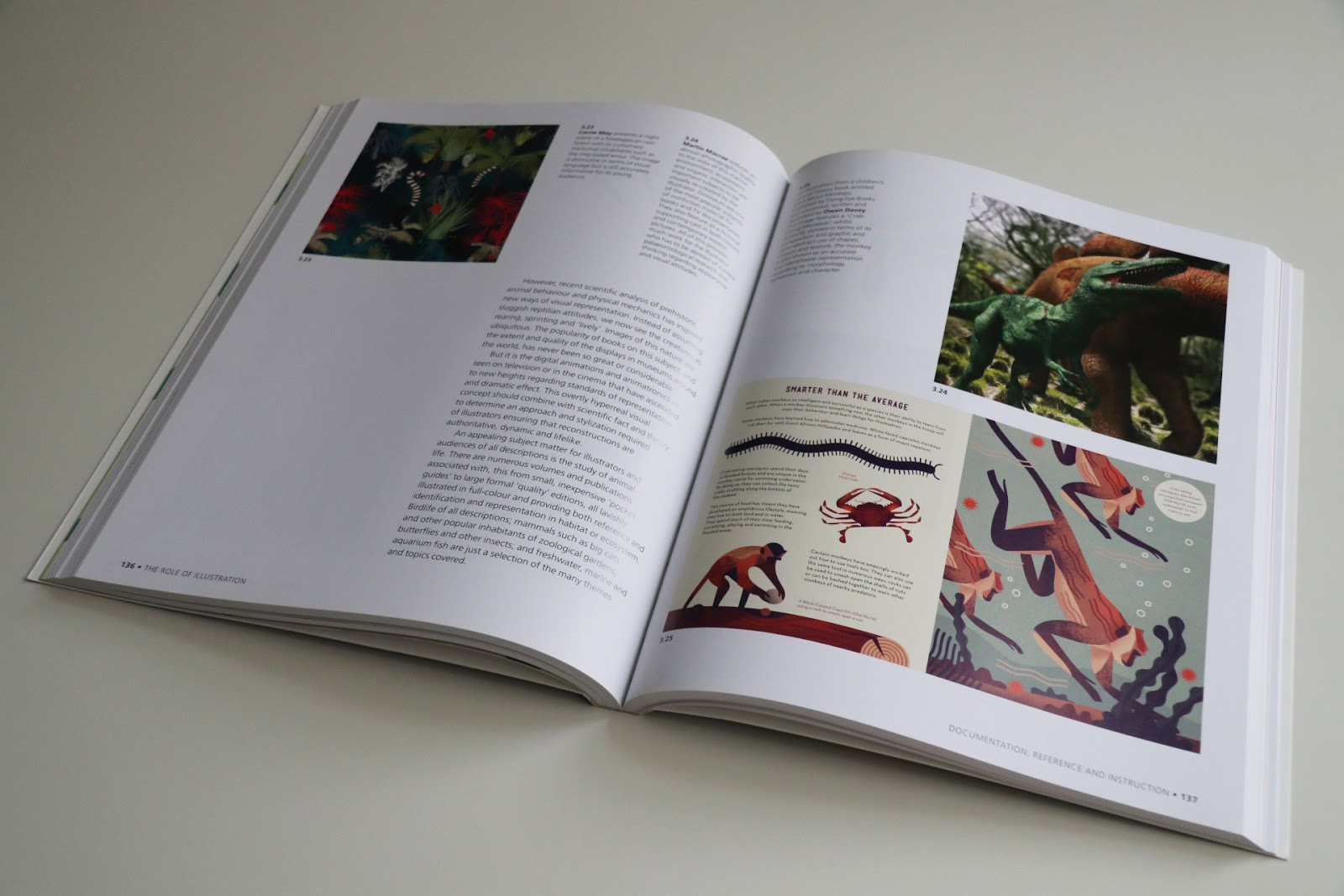
For a book that is supposed to display the power behind visual media and the relevance of illustrated products the size afforded to some of the examples doesn’t really work. Poster sized illustrations shown at postage stamp size, why? Cartoon strips where you can’t read the speech bubbles, why? The layout of the book should allow the power of the illustrations to shine through as many art books do. This problem is not exclusive to this book. That being said the images are carefully and appropriately captioned to help the reader to appreciate the context for the work and the manner in which drawing is utilized to communicate value.

Alan Male states that illustration isn’t self-expression but self-expression does lie at the heart of visual curiosity. Illustration is a commercial enterprise that has managed to maintain its relevance and importance regardless of technological advances and changing social mores. The section on how illustrators collaborate with science is really engaging and points to several ways that the status of imagemakers can be enhanced. As a Professor of the subject Male knows his onions and fully embraces the variety of construction methods and complex applications used by those of us who channel image as our choice of visual communication.  

This book contains a broad range of approaches deemed illustration and how this work impacts on the wider society. Though dry to read in places this book is rich in description, breadth and scope of this subject. It is clear that the illustrator is at the heart of the destiny of this profession not industry. Alan Male advocates that illustrators should be consulted at the start of a commission and we are essential to the development of dynamic and significant work. We are most definitely not ‘colouring in technicians.’


19 February 2017


Wednesday, 30 November 2016

Communication Design Insights from the Creative Industries – My book review on AOI blog

Written by Derek Yates and Jessie Price