My review for Graham Carter's new picture book, 'The Story Thief' - hosted on the Association of illustrators review Blog here


My review for Graham Carter's new picture book, 'The Story Thief' - hosted on the Association of illustrators review Blog here
Written & Illustrated by Neil Packer
ISBN: 978-1-4063-7922-8
Published by Walker Studio
A.O.I. Book Review can be found here.
Neil Packer’s Website http://www.neilpacker.co.uk/


Editor Gabriel Solomons
Published by Beneficial Shock! Ltd. ISSN: 2399-5173

“I wasn’t interested in “illustrating” them in the usual literal way, which I’ve always regarded as redundant and insulting to a viewer’s intelligence and imaginative capacities. I was more interested in the possibilities of apparently disparate juxtapositions and the new worlds that might emerge.” Russell Mills
Issue Five of the pioneering cinematic publication has arrived and it continues to build upon the campaigning strategy “to see more creative editorial expression” through the exploration of meaning within filmmaking and cinema. Early on in the magazine the publishers make statements of intent which are worth mentioning as others should note them too:
On page 2, “We aim to retain independence in order to support creative collaboration and provide professional opportunities for young and emerging creative talent.”
On page 3, “We aim to challenge the traditional role of the visual creative from a content servicer to that of an author researcher and content ‘driver’ – adding value and responsibility as a visual communicator.”
The theme for this issue is SECRETS & LIES. The contents page has its structure divided into Covert on the left and Untruths on the right. The Features articles drill down into the conceits that are inherent in the very structure of film, and how classic and modern narratives are shaped by geo-political, cultural and societal upheavals. The writing is impeccable as all concerned are passionate about communicating ideas that are underpinned by artistic rigour.
Once again Art Director Phil Wrigglesworth’s wraparound cover illustration is an epic scene containing visual references mined from the entire contents of the magazine. We see images from the Coen Brothers oeuvre, a recumbent Statue of Liberty with a deflated Superman and some naked figures descending into darkness. All of this detail displayed using a palette of only three colours.
I have continued to refine my own critical appreciation of film since I reviewed issue one of this magazine, so I was looking for a challenge and I was not disappointed. Notable for me are the articles ‘Not So Super After All’ by James Charisma & Jason Raish, ‘Once Upon A Dream’ by Neil Fox & Ryan Jackson, ‘The Parent Trap’ by Thomas Puhr & Ryan Snook and Jonny Hannah’s ‘Anarchy In The UK: Ealing Comedies’ a combination of energetic print techniques and droll commentary with text as image, or is that image as text?
At 80 pages the magazine has grown, but not through the addition of advertising that plagues many other periodicals. I’ve noticed that the articles advance a more polarized viewpoint that reflects the tensions between the power of old patriarchy and something that appears much freer and progressive on the surface.
The diversity of the source material drawn upon is also something I find to be very positive. Who knew that the real force behind ‘The Man With the Movie Camera’ was a woman? The editorial stance seems less shocking this time and more contemplative, which I think suits this complex theme. I’m glad that the magazine has endured as we are possibly at a crossroads that might do away with the cinema altogether. However, that said I look forward to reading issue six which takes as its theme COURAGE & STRENGTH – something that we all need right now.


Edited by Julian Bell, Julia Balchin & Claudia Tobin
ISBN: 978-0-500-02190-3
Published by Thames and Hudson
Reviewed by Karl Andy Foster
Publishers website https://thamesandhudson.com/catalog/product/view/id/4957/s/ways-of-drawing-9780500021903/category/2/

Review
From the first moment that humans discovered that they could express ideas through mark making we haven’t been able to stop. Though we have yet to completely exploit the creative potential of ‘dirtying the paper’ who better to discuss the practice of drawing than the practitioners themselves. There is also the need to ensure that the power of drawing is promoted to wider-audiences. If you can engage people with this topic, you might also be able to encourage participation. The excellent introductions by Julian Bell that lead us into each chapter are thought provoking and connect the distinct elements.
This book is divided into three main sections: Studio Space (where we go to find a place to make things happen and to work in private meditation), Open Space (Go outside start drawing and count how many people interact with you and mention their own lapsed drawing practice) and Inner Space (where influences that run deep into the sub-conscious are able to surface and startle the artist!). We are able to glimpse the personal, reflective and in some cases passionate evocation of the compulsion to make sense of the world through mark-making.
Some of the contributors to this book wish to educate while others simply celebrate the act of drawing, caring less about whether this is a worthy practice or not. The amateur and the professional, the academic and the unconscious doodler all have their part to play in the debate. The range of essays on offer are from artists who know how to capture the essence and inner truth of the subject. By resolving ideas through the distillation of feeling and emotions that are elicited from reading our external world.
In the essays the artists attempt to discover the secrets of this skill and explain that preparation is everything. Through the history and evolution of the subject we see that drawing as an essential part of our visual culture. This book features incredible drawings and a multitude of approaches. It is important to read the images first and then the text, however some of the drawings hold one’s attention so well that you forget to continue to read the text. It also explores the meaning of image-making through the use of historical and contemporary examples. Drawing is an enterprise that has remained relevant and important despite the invention of photography and cinematography and our changing social interactions. Some artists make clear the strong case for when observed drawing is superior to all other forms of expression.
Good drawing is hard to achieve and even harder to share one’s output with others. When I think about drawing I am filled with a sense of dread and I know that this anxiety stems from one thing and one thing only. There is a level of competency a ‘standard’ if you will that is set within us during foundation studies that is clear. We want to produce good drawings not dross. We are very ashamed of the dross. Ways of Drawing goes some distance to unpack the meaning and reasons behind this ‘standard’ and debunks a few myths too.
25 April 2020


Written by Lucy Brownridge
Illustrated by Édith Carron
ISBN: 978-1-78603-645-2
Published by Wide Eyed Editions
Reviewed by Karl Andy Foster
Publishers website https://www.quartoknows.com/books/9781786036452/Portrait-of-an-Artist-Vincent-van-Gogh.html?direct=1
Édith Carron’s website https://edithcarron.net
Pitch
A cultural titan who still influences the art world more than 100 years after his death. He is a man who is so well known and loved as a result of his tragic suffering, the letters to and from his brother Theo and his peerless artworks. If you publish a book about Vincent Van Gogh it is bound to succeed.

Review
A famous face stares out at us from the cover of this hardback book. Vincent Van Gogh is surrounded by the subjects of his trade; sunflowers, cypress trees and a swirling combination of clouds and sky. A palette that is evocative of a sun blasted summer’s day. This is a portrait of an artist who was unlike any other in the history of western art. Wide Eye Editions have published an enjoyable addition to their series that features great artists and their lives.
Édith Carron has done a remarkable job considering that she is competing with examples of Van Gogh’s own works. Her bright unfussy colours and delicate pencil work are combined to create the tableaux of his life and times on double page spreads. With a few well-placed marks Carron is able to suggest fine detail but without over-working her drawings.
This painful tale is handled with sensitivity and restraint by Lucy Brownridge. She allows us to see all the key moments from Vincent’s short life. If a young reader wants to know more about the history behind the paintings then this can be found on the last three pages of the book. This compliments the story and adds some important details about his more famous paintings.
This is the story of a man who lost his life as lovers often do in fables of long ago. There was possibly no other artist of this period capable of creating a work like The Starry Night – sublime. This is a simple but effective addition to the many books on this subject. Why would you want another book about Van Gogh I hear you say? I say, you would want this one!
17 October 2019


Written by Chiara Mezzalama
Illustrated by Régis Lejonc
ISBN 978-1-911496-16-8
Published by Book Island
Reviewed by Karl Andy Foster
Publisher’s website https://www.bookisland.co.uk/products/the-garden-of-inside-outside?_pos=1&_sid=bf411036a&_ss=r
Illustrator’s website https://www.ricochet-jeunes.org/auteurs/regis-lejonc

This is a story that sets out its context carefully as the events that surround and impact upon our young protagonist Chiara requires sensitive handling. A memoir framed against a turbulent period in the history of the middle east evokes the author’s remembrances of things past.
With similarities to a propaganda poster the cover of this graphic novel shows two children linking hands in a beautiful garden. Above their heads and outside the inside is the image of the Ayatollah Khamenei in ominous red and black. The paper stock also adds to this quality. On some pages there is not the conventual linear story but instead images that could be self-contained and work in their own right.
Throughout the story at the top of the pages we see either the word OUTSIDE in red to indicate danger or INSIDE in green for the more peaceful moments. Towards the end both OUTSIDE and INSIDE are shown together once another child Massoud enters the garden. Through their interactions the children process the realities of the world outside. They shape their fears into adventures and shared values into friendship.
The illustrations in this book remind me of linocuts or wood block printing. The limited palette of green, blue, red, yellow with black outlines helps to reinforce this impression. From arches to decorative tile work, from illustrated carpets to lush vegetation gone wild the line work is fluid and flows well. The drawing style is a combination of the powerful details found in David B.’s work and the graphic boldness of Marjane Satrapi’s illustrations.
This is a delightful story about friendship in unusual circumstances. Based on the biographical events of the author’s life and set during a time of revolution and war, it is the precious moments that cement our personalities and create the myths of our early years. At the end of this story there is a moment that reminds me of a line from A. E. Housman’s ‘A Shropshire Lad.’
“That is the land of lost content, I see it shining plain,
The happy highways where I went
And cannot come again.”
This graphic novel is proof that it is necessary to relive your past and to share this with others.
9th March 2020


Written by Anna Castagnoli
Illustrated by Carll Cneut
ISBN 978-1-911496-14-4
Published by Book Island
Reviewed by Karl Andy Foster
Publisher’s website https://www.bookisland.co.uk/products/the-golden-cage?_pos=1&_sid=51334d043&_ss=r
Illustrator’s website https://blog.picturebookmakers.com/post/162038451911/carll-cneut

Review
The title of this oversized picture book is worth remembering as you read through the sumptuous illustrations and sensitively delivered text. The golden cover is composed of birds of every exotic variety with a conscious nod by the artist to the bird illustrations of Edward Lear, John James Audubon and the legendary Brian Wildsmith. The Emperor’s sullen daughter is the only sour note within this image. She is a great foil to the avian magnificence surrounding her.
The Emperor’s daughter referred to here as the Bloody Princess demonstrates how she got this moniker every chance that she gets. She is an obsessive brooding child who know no boundaries. Her lurid dreams lead her to demand that her servants bring her extraordinary bird after extraordinary bird! Her servants dare not disappoint her and sometimes they don’t return at all. For a book aimed at children aged 6 plus the story is firmly in the mold of a dark European fairytale.
Carll Cneut is an artist who possesses a masterful range in his painting and drawing approaches. He has designed each spread with the precision of a graphic designer (the typography also works as image in some cases) and the bravura of an expressionist painter. In addition to the cover his notable spreads include the pin board of birds that contain one of ‘Big Bird’ from the TV show Sesame Street, the one with the 101 numerals in yellow positioned across the pages, the red flower image where the skulls begin to appear for the first time, the final servant surrounded by the empty bird cages and the green page where the final servant finally delivers the talking bird to the Princess.
This tale of the Bloody Princess leaves us wondering what will happen next as the imagery gives way to written pages that raise more questions than they answer. This is a complex picture book that will draw out the curiosity of children and adults too as the illustration and the writing work on multiple levels. There is enough here to have one return to its pages time after time.
7th March 2020


Written & Illustrated by Sydney Smith
ISBN: 978-1-4063-8840-4
Published by Walker Books
Reviewed by Karl Andy Foster
Publishers website http://www.walker.co.uk/Small-in-the-City-9781406388404.aspx
Sydney Smith https://www.sydneydraws.ca
Pitch
This is something special. Sydney Smith’s narrative power is his ability to immerse the reader into the world and concerns of a small child. His spare economical prose and exquisite artwork propels you towards a startling destination. This is an honest and credible story that after drawing you in leaves you satisfied, perhaps with one or two tears in your eyes.

Review
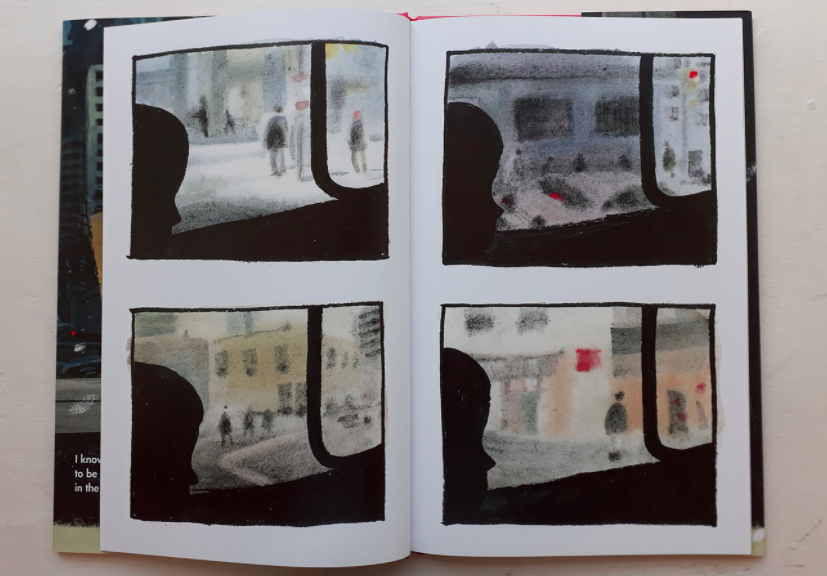
In this hard cover picture book there are some lovely observations visual and textual. The initial four panels with the silhouettes and blurred streets convey the sense of unease. A child roams around the city encountering a range of scenarios and offers advice that may or may not be of comfort to a stranger.
Sydney Smith’s carefully constructed pages are a mixture of full spreads and panels. Of note is the double page spread when the child leaves the bus and makes their way into the throng of the crowds. In addition, the words “I know what it’s like to be small in the city” or “The streets are always busy. It can make your brain feel like there’s too much stuff in it.” I particularly enjoyed “Alleys can be good shortcuts. But don’t go down this alley it’s too dark.” We are completely involved with the concerns of our young protagonist.
The grid lines of buildings, walk ways and street furniture create a web suggesting a trap for the uninitiated. There is a stunning picture of the child’s reflection fractured by the arrangements of the mirror tiles on a building façade. We soon realise that this advice is not aimed at the reader but at something far more important. The revelation at the end of the picture book came as a surprise for me but I did start to get an inkling of what was to come.
Sydney Smith has created a classic that will make a big impression on readers with a story that though simple is imbued with a graphic fluidity combined with a visual dexterity that few can match. This for me is reminiscent of Ezra Jack Keats’ atmospheric The Snowy Day when I read it for the first time. The artwork nods in a knowing direction towards Dave McKean’s ‘Cages’ and ‘The Savage.’ The use of a subtle and sophisticated palette suffused with interpretive impressionistic inky marks and charcoal lines is thrilling.
If this picture book and his 2017 Kate Greenaway Medal winning collaboration ‘Town Is by the Sea’ written by Joanne Schwartz is anything to go by Sydney Smith is on his way to great significance. When you are small in the city you can still have the biggest heart of all.
08 October 2019


Written by Zoë Tucker
Illustrated by Zoe Persico
ISBN: 978-0-7112-5375-9
Published by Frances Lincoln Children’s Books
Reviewed by Karl Andy Foster
Publishers website https://www.quartoknows.com/books/9780711253773/Greta-and-the-Giants.html?direct=1
Zoe Persico website http://www.zoepersico.com

Review
Greta Thunberg is a 17-year-old, Swedish school child who has become famous through her stand to save the world, beginning when she was 15 years old outside the Swedish Parliament one Friday afternoon. I have written reviews for stories about living people before and it’s usually a real-life account that has been adapted to help craft the story into a cohesive narrative. This time a real person has been cast in a fictional tale to help children grasp the concept of activism.
The cover is like a poster for a classic Western movie where our heroine stands legs apart ready for the final showdown with an unknown foe. Her face is stony in its resolve but her weapon is a large placard stating “Strike for Climate.” In the background are two silhouetted figures, could these be the Giants mentioned in the books title? The production of this book using UK based suppliers and printers align with its ethical stance. Greenpeace is a beneficiary of the sales of this book.
Zoë Tucker has framed this story of defiance into a magical fable in the mold of Hans Christian Anderson or a Charles Kingsley creation. Children take on the adult world because they have to in this story. In such cases of adversity, we need the children to ask themselves if it’s possible to inspire by your words and actions and can they see themselves as capable of making a difference to the world. Greta has spoken truth to power across the globe and has as many fans as detractors, therefore she must be doing something right.
Zoe Perisco’s illustrations are bold, sophisticated, loose, dynamic using subtle tones of yellow, purple, brown, sage and hooker green. The figuration of the giants helps us to appreciate that they are engaged in their lives without much thought for the impact their desires are having on the planet. There are striking spreads in the book e.g. the city consuming the forest, the children marching, placards in hands and the resolution images showing us what the world could be like if we all acted to save it. The three circular vignettes towards the end of the story are rather ambiguous despite the text underneath them. The text refers to the behaviour of the Giants after Greta confronts them but the images look more like the children characters who are doing the protesting. I do wonder if an error has been made here.
We want our children to be the future but it is a complex matter these days. What will happen? Will the real Giants think about changing the world or is this an impossible future? Can children convince adult readers to engage with change to make a difference? Out of small acorns mighty oaks spring forth.
21 February 2020


